
Parallel Parenting vs Co-Parenting: Which One Do You Actually Need?
· 10 min read · by the SyncParenting team
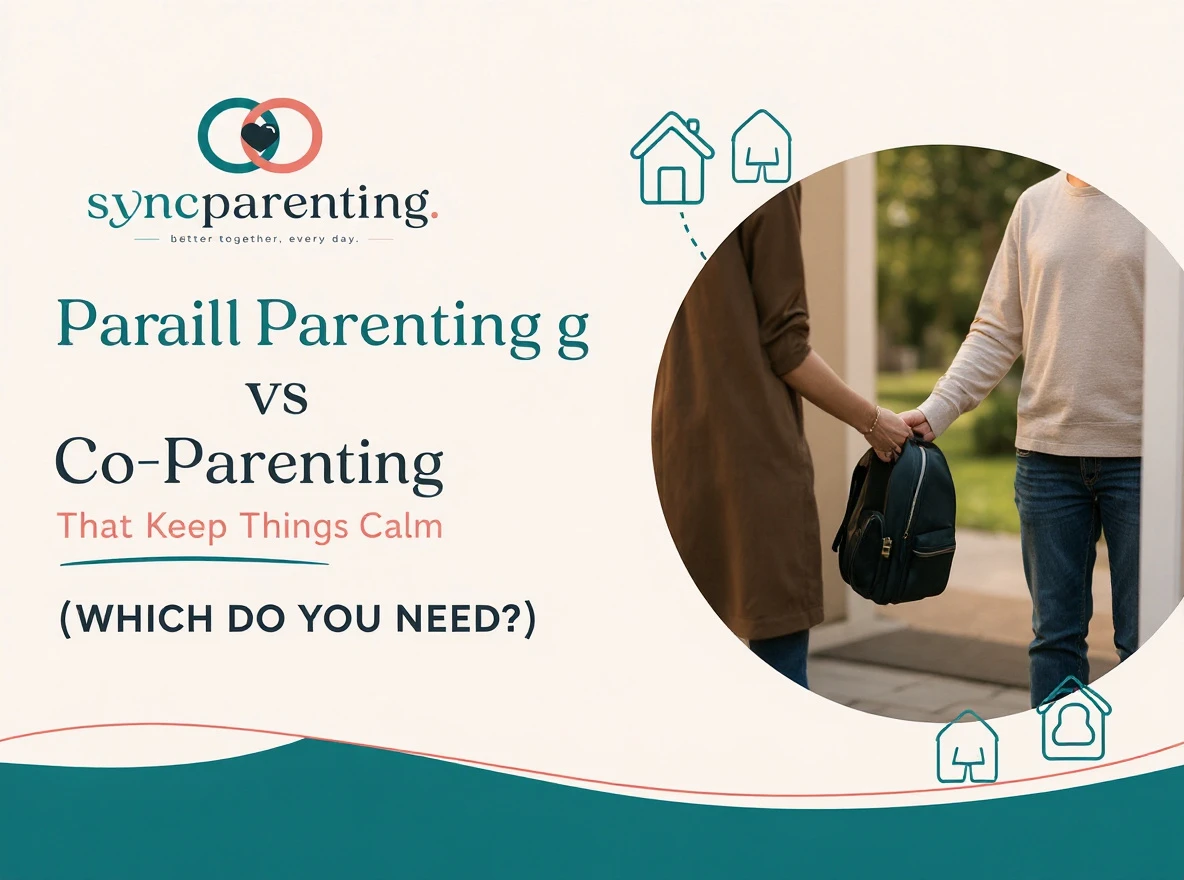
If a therapist or attorney has mentioned parallel parenting and you're not sure what it means — or whether it's an admission of failure — this guide is for you. The short version: parallel parenting is a structured way to raise your children well even when you and your ex can't cooperate. It isn't giving up. For a lot of families, it's the thing that finally lowers the conflict your kids have been absorbing.
What is co-parenting? (And why it doesn't work for everyone)
Traditional co-parenting is cooperative and child-centred: both parents communicate regularly, coordinate routines across two homes, attend events together, and make joint decisions without much friction. When it works, it's wonderful for kids — they feel both parents are on the same team even though the marriage ended.
But co-parenting requires two willing, reasonably regulated participants. If one parent is high-conflict, has narcissistic traits, or is simply uncooperative, every attempt at 'cooperation' becomes another opening for conflict. It's worth saying plainly: not every separated family can co-parent cooperatively, and that is not a reflection of your worth as a parent. Sometimes the most loving thing you can do is stop trying to force a cooperation the other person won't offer.
What is parallel parenting?
Parallel parenting is an arrangement where each parent parents independently during their own time, with minimal direct contact between the adults. You both stay fully involved with your children — but you disengage from each other.
Its core principles are disengagement (you stop trying to manage or persuade your ex), structured handoffs (predictable, low-contact exchanges), and written-only communication limited to essential logistics. It's specifically designed for high-conflict separations, a narcissistic or controlling ex, or situations where contact has been emotionally abusive. Think of it this way: parallel parenting isn't giving up — it's protecting your children from the parental conflict that actually harms them.
Co-parenting vs parallel parenting — the key differences
Neither model is 'better' in the abstract; they fit different circumstances. Here's how they compare across the dimensions that matter most.
- •Communication style: Co-parenting is frequent and flexible; parallel parenting is minimal, written-only, and logistics-only.
- •Handoffs: Co-parenting handoffs can be casual and friendly; parallel parenting uses neutral locations like school to avoid contact.
- •Decision-making: Co-parents decide together in real time; parallel parents split decision-making domains (e.g. each handles day-to-day choices on their own time) per a written plan.
- •Flexibility: Co-parenting allows easy swaps; parallel parenting sticks rigidly to the written schedule to remove negotiation.
- •Conflict level: Co-parenting suits low conflict; parallel parenting is built for high conflict.
Signs you need parallel parenting, not co-parenting
How do you know which one you're in? Look honestly at the pattern, not the occasional bad day.
- •Your ex uses nearly every interaction as an opportunity to start a conflict.
- •Conversations about the children reliably escalate, no matter how calm you stay.
- •You feel anxious or unsafe around handoffs.
- •Your children are being used as messengers or made to take sides.
- •Your ex refuses to follow arrangements you've already agreed.
If your ex has narcissistic traits
When the other parent has narcissistic traits, ordinary co-parenting advice — 'just communicate more,' 'be flexible' — tends to backfire, because more contact simply means more opportunities for control and conflict. Parallel parenting removes those openings. If this is your situation, our dedicated guide on co-parenting with a narcissist covers the grey rock method and documentation in depth.
How to set up a parallel parenting plan
A parallel parenting plan works because it removes ambiguity. Build it in this order:
- •Step 1 — Get it in writing. Formalise a detailed parenting plan through court or mediation, so the rules don't depend on goodwill.
- •Step 2 — Set communication rules. Email or a co-parenting app only, a defined response window (e.g. 24–48 hours), and a ban on emotional topics. See our communication guide for the templates.
- •Step 3 — Plan low-contact handoffs. Use school or a neutral third party so the two of you rarely have to meet.
- •Step 4 — Build a detailed custody schedule. Spell out every regular day, holiday, and vacation so there's nothing left to argue about.
- •Step 5 — Document everything. Keep a calm, dated record of handoffs, schedule changes, and any deviations.
Parallel parenting tips that actually work
- •Use a dedicated email address solely for co-parent communication, so it never bleeds into the rest of your life.
- •Never deviate from the written plan without documenting the change in writing.
- •Keep the children's two homes separate — different supplies, routines, and rules are fine; kids adapt.
- •Don't interrogate your children about the other parent's home.
- •Stick to the schedule religiously. Predictability is what reduces conflict; every exception invites a negotiation.
Can parallel parenting switch back to co-parenting?
Yes — and many families do, as children get older and the early-separation intensity fades. The shift usually requires three things: both parents genuinely willing, enough time elapsed for trust to rebuild, and sometimes therapeutic support.
But don't force it, and don't treat parallel parenting as a failure if it stays permanent. Plenty of families parallel parent successfully for years because it's simply what works. The goal was never a friendship with your ex — it was stable, low-conflict childhoods for your kids.
Frequently asked questions
Is parallel parenting legally recognised?
Parallel parenting isn't a separate legal status, but courts routinely approve parenting plans built on its principles — minimal contact, written communication, and structured handoffs. You can ask for these specific terms to be written into your custody order.
What if my ex won't agree to parallel parenting?
You don't need their agreement to start disengaging on your side: you can limit communication to written logistics, stick rigidly to the schedule, and document everything. For the structural pieces — handoff locations, decision-making domains — you can request them through mediation or court.
How do we handle school events and medical decisions with parallel parenting?
Plans usually assign decision-making domains and allow both parents to attend events independently (arriving and leaving separately). Schools and medical providers can typically send information to both parents directly, which removes the need for you to relay it.
Is parallel parenting bad for children?
No — the research consistently shows it's parental conflict, not separation itself, that harms children. By reducing the conflict kids are exposed to, parallel parenting is often far better for them than a 'cooperative' arrangement that produces constant tension.
Can I request parallel parenting in a court order?
Yes. You can ask the court to include parallel-parenting terms such as written-only communication, neutral handoff locations, and clearly divided decision-making. Documentation of past conflict strengthens that request.
Keep reading
· 8 min read
The 5 Best 50/50 Custody Schedules (With Real Examples)
· 7 min read
How to Split Child Expenses With Your Co-Parent (Without the Fights)
· 6 min read
12 Co-Parenting Communication Rules That Keep Things Calm
· 12 min read